
Get the birds out of your dryer vent and keep them out
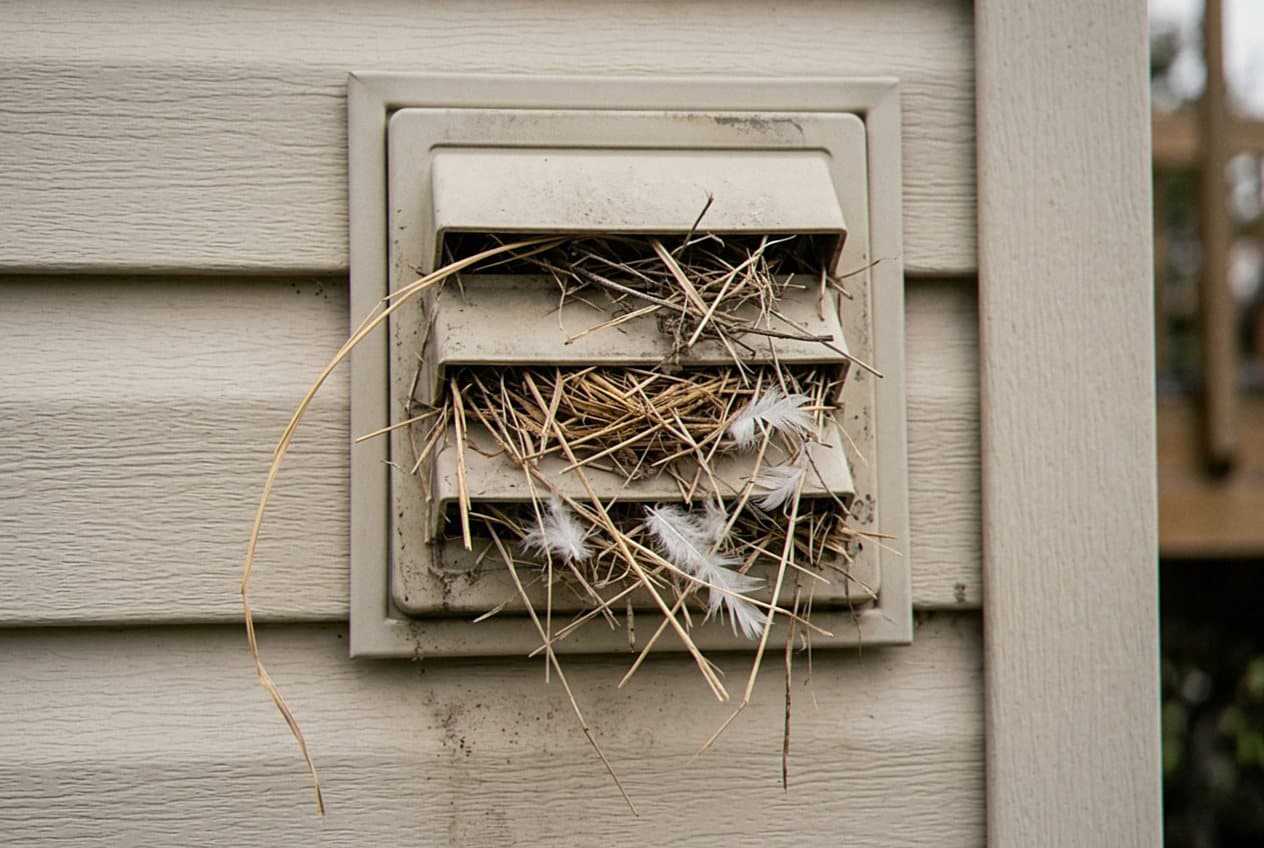
You usually hear it before you see it. Scratching in the laundry room wall, then a thin chirping early in the morning, right about the time the sun comes over the roof. Sometimes the first clue shows up at the dryer instead. Clothes come out damp, the machine runs hot, and the room fills with warm air that should be going outside. Then you walk around the house and look up. Straw and small twigs hang out of the vent hood, the little flap is propped open, and there is a smear of droppings down the siding below it. That is a nest, and it sits in the one part of your duct that has to stay open. Birds pick these hoods for good reason. The opening is a hole in a warm wall, it faces away from the wind, and the flap gives cover from rain and from hawks. House sparrows and European starlings do most of this work in our area. They start scouting in March, build through spring, and many pairs raise more than one brood before the summer is out. A finished nest can fill the first two or three feet of duct with dry grass, straw, feathers, and scraps of plastic bag. Dry grass packed against a heat source is a real problem. Fire agencies list blocked vents among the leading causes of clothes dryer fires, and a nest blocks a vent faster than years of lint ever could. There is more going on than airflow. The exhaust cannot leave, so heat and damp back up into the duct and into your laundry room. That moisture ends up in the wall cavity. We find soft drywall, peeling paint, and a musty smell in houses where a nest sat through one wet spring. Nest material also carries mites, and those mites do not stay in the vent once the birds are gone. Older frame homes on the east side of Elgin, near the historic district along the Fox River, tend to have hoods low on the wall where they are easy to reach and easy for a bird to find. Newer places out toward Randall Road often vent through the roof or high on a gable, which puts the nest out of sight until the dryer starts acting up. Either way the fix is the same. The nest has to come out, the duct behind it has to be cleared, and the opening has to be closed off with something that still lets exhaust air pass. Timing matters here. Once eggs or chicks are in the nest, the job changes, and the rules change with it. So the sooner you call after that first scratching sound, the simpler this stays.
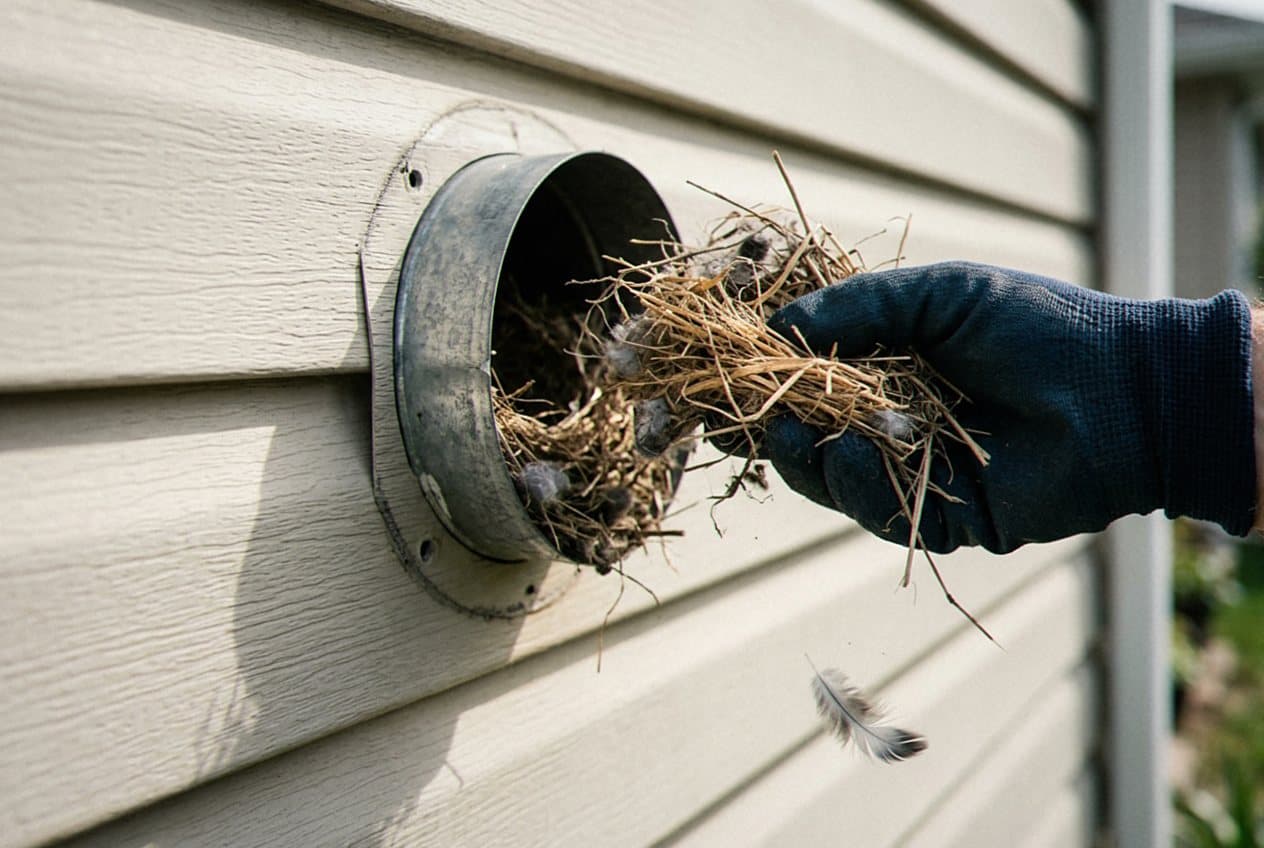
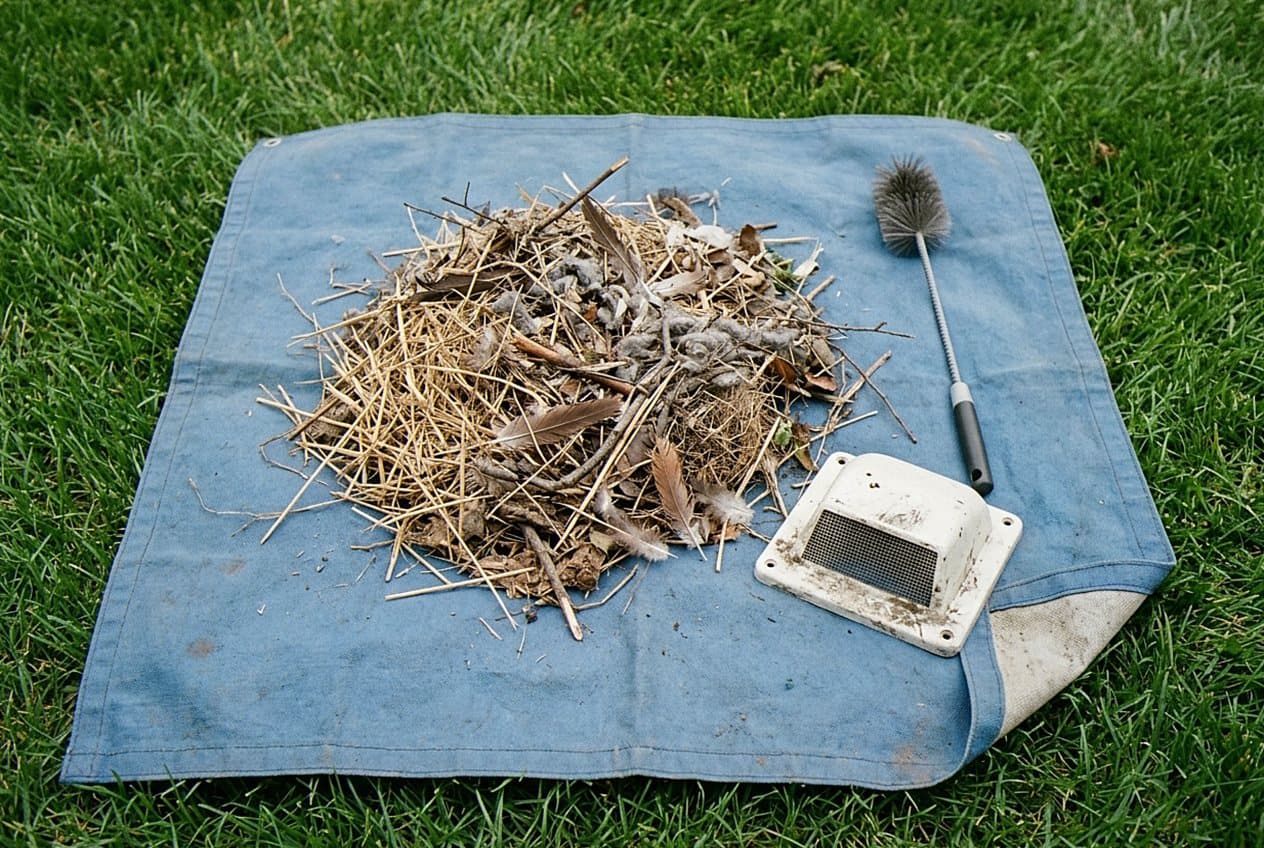
We start outside, at the hood, because that is where the nest lives. The dryer gets unplugged first so nothing kicks on while a hand is in the duct. Then we open the hood and look. If the nest is empty, we take it out whole, by hand and with a vacuum, and we bag the material rather than dropping it in your beds. If there are eggs or young birds in there, we stop and say so. House sparrows and European starlings are not protected under federal migratory bird law, so an active nest of either one can come out. Most other birds are protected, and for those the honest answer is that the nest waits until the young can fly. We will tell you which bird you have, and we will tell you plainly what we can do about it today. Once the nest is out, the duct behind it gets cleaned the same way any packed run does. Nest material never stops at the hood. Grass and straw get pushed deeper every time the dryer runs, and it mixes with lint into a mat that a shop vacuum cannot touch. We run a rod with a spinning brush head the full length of the duct while a vacuum with a fine filter holds suction at the other end. Packed spots get pulsed with air until they break apart. Then we clean the hood itself, free the damper flap so it swings open and falls shut on its own, and check the pipe for the damage birds leave behind. A flap that no longer closes is what let them in. A flap that got bent while a bird forced past it will let the next one in too. Damaged sections of duct get replaced with metal pipe, sealed with foil tape at the joints. No screws go inside the run, since a screw tip in the airstream catches lint and starts the whole cycle over. Last comes the part that keeps this from repeating. A guard goes over the opening, sized so exhaust and moisture still leave freely while a bird cannot squeeze past. This is not a window screen. Screens over a dryer hood catch lint on purpose and clog within weeks, and we take those off when we find them. A proper guard uses wide bars or a cage with real spacing, mounted so it never fights the flap. Then we run the dryer on heat and check the air at the opening with you standing there. Cleanup is part of the visit. Nest debris and droppings go into a bag and leave with us, the siding under the hood gets wiped down, and the dryer goes back with slack in the hose instead of a kink against the wall.
- The nest comes out whole and the duct behind it gets cleared, so the grass and straw that got pushed deep on the last few loads comes out too. Half a job leaves a plug three feet inside the wall that you cannot see and cannot reach. It stays there, it soaks up lint, and the dryer keeps struggling.
- The opening gets closed with a guard that birds cannot pass and exhaust air still can. That is the difference between a fix and a yearly chore, because an open hood on a warm wall will be found again next spring. Birds return to the spot that worked, and often to the same wall on the same house.
- Blocked exhaust means heat and damp with nowhere to go. Clearing it takes the fuel and the moisture back out of your wall, so the dryer stops running hot against a plug of dry grass and the laundry room stops steaming up. A machine that vents freely also stops tripping its heat cutoff.
- Nest debris and droppings leave in a bag, not on your lawn. Mites travel in that material, and we would rather carry it out than shake it loose under the vent and let it find its way back into the house. The siding under the hood gets wiped down before we pack up.
- We tell you which bird you have and what that means for timing. If there are eggs or chicks in there and the birds are protected, we say so straight instead of pulling the nest and handing you a problem you never asked for. When that happens we set the return visit and secure what we can in the meantime.
Spring is the busy stretch for this work, and it runs longer here than most people expect. Nest calls start in March, peak through May and June, and trail off in August when the last brood leaves. Kane County weather sets that clock. A warm wall with a hole in it is worth a lot to a bird in a cold April, and our April is often still cold. Then there is the other half of the year. Winter does its own damage to a vent hood. Ice builds on the flap, the plastic gets brittle, and by the time the snow is gone the flap no longer seals. That is the hood a bird finds in March. The two problems feed each other, and the houses we visit for nests in spring are very often the ones with a flap that failed in February. We cover Elgin and the towns around it. South Elgin, Bartlett, Streamwood, Carpentersville, Gilberts, East Dundee, West Dundee, Hoffman Estates, and St. Charles all sit in our normal week. The housing tells us most of what we need before we arrive. Older frame homes on the east side of the Fox River usually vent low through the rim, which is quick work off a step ladder. Split levels and two story colonials in the subdivisions west of town often vent through a gable or the roof, and that means a taller ladder and a longer rod. Townhomes and condo buildings can share a whole wall of hoods, and when one unit has a nest the neighbors usually have one as well. We say which of those you have on the phone, so nobody is standing in the driveway guessing. Rental owners call us for the same reason. One vent full of grass in April turns into three by June if nothing gets closed off. When we walk a building we check every hood, not only the one the tenant reported. That saves a second trip, and it saves the tenant on the far end from a laundry room full of steam in July. Restaurants, salons, and small shops with a laundry room out back get the same treatment, since a hood behind a building sits quiet all day and birds notice that. Getting on the schedule is simple. Tell us the address, where the hood sits on the house, and what you have seen or heard. Chirping, twigs hanging out, a flap stuck open, or just a dryer that quit drying. That is enough for us to plan the visit and bring the right ladder. We answer our own phone and we book quickly, because a nest in a vent is not something to leave sitting while the dryer runs hot behind it.
Call us and tell us what you are hearing at the wall or seeing under the hood. We will tell you what usually causes it and what the fix looks like on a house like yours. Then we get out to Elgin, pull the nest, clear the duct behind it, and close the opening so next spring stays quiet. Elgin homes, Elgin phone, and a straight answer either way.