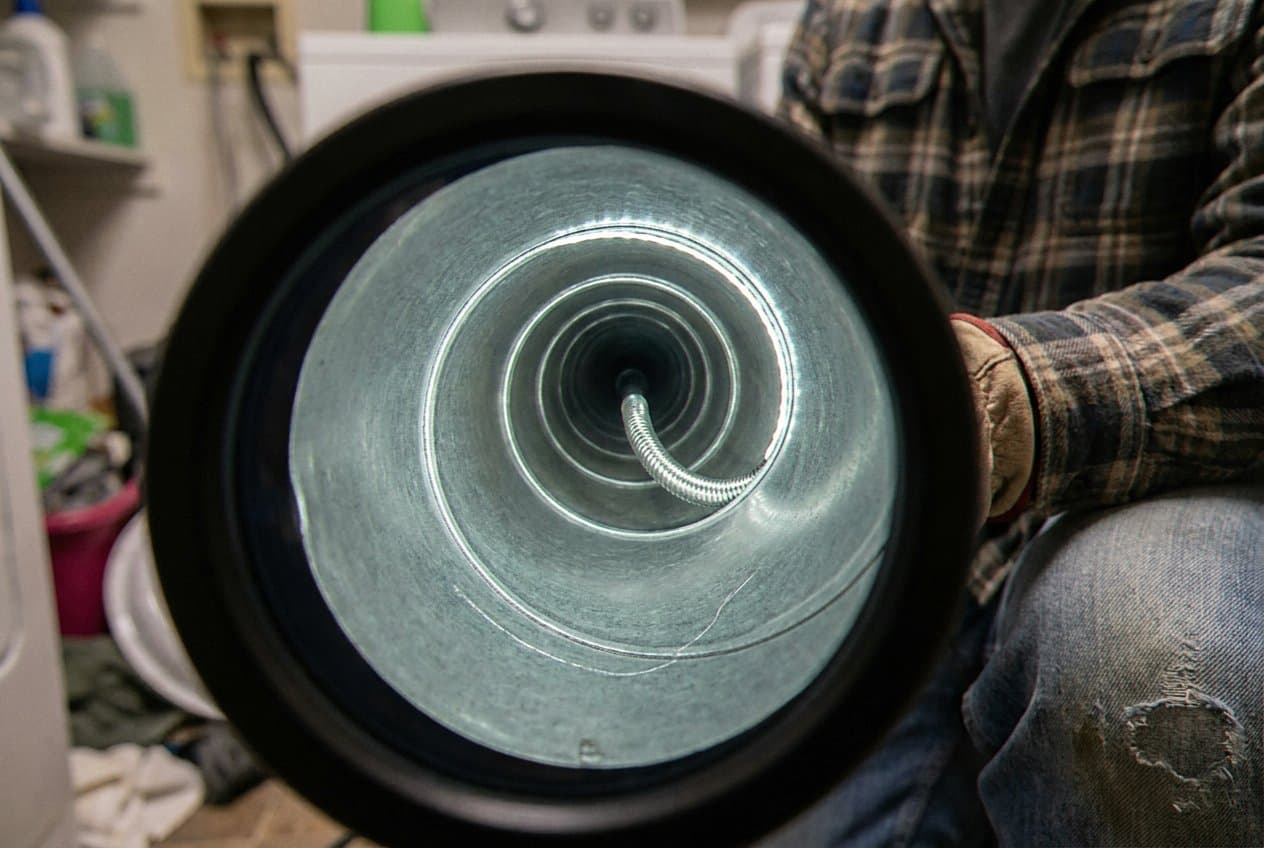
Dryer Vent Cleaning
We clear the whole vent line, machine to hood, so your dryer finishes a load in one cycle again.
Learn more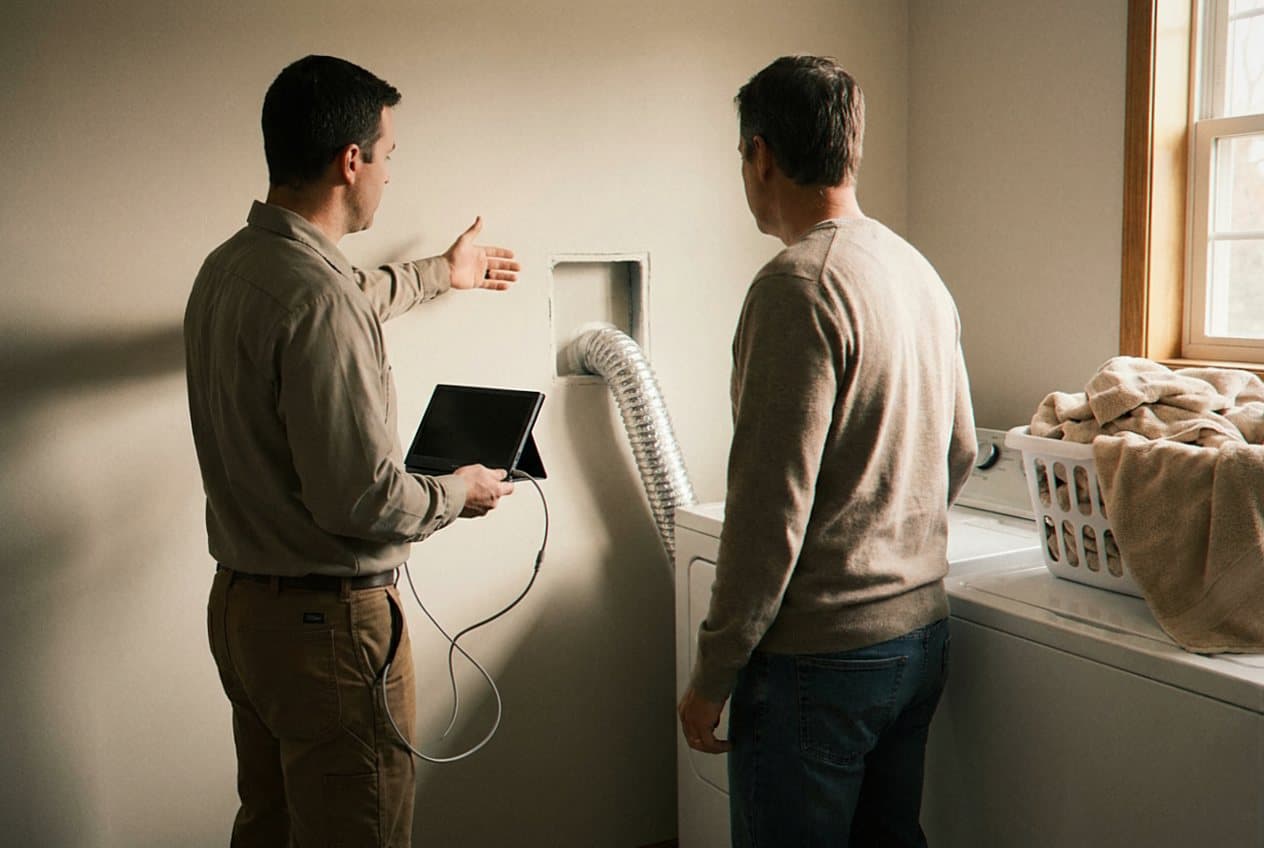
Dryer vent cleaning for Elgin homes and small buildings. One call, a real time window, and a crew that pulls the lint out and shows you the pile before we go.
Most people call us after the same thing happens. A load of towels comes out damp, so they run it again. The dryer feels hot to the touch. The laundry room smells warm and a little burnt. That is lint, packed inside the duct, choking the air that should be leaving your house. Dryer vent cleaning fixes it. We pull the dryer away from the wall, take the hose off the back, and run a spinning brush through the whole line while a vacuum catches what breaks loose. Then we go outside, open the hood, and clear the last few feet where lint and damp air pack together into a felt plug. You get the pile in a bag so you can see it. Most homes in Elgin go two or three years without anyone touching that duct. In that time a soft gray mat builds along the walls of the pipe, and the dryer starts working twice as hard for half the result.
Elgin homes make this job different from street to street. Downtown, near the old houses off Douglas and Chapel, the laundry sits in a stone basement and the duct climbs up and out through the rim joist. Those runs are short but they bend a lot, and every bend collects lint. Out west, past Randall Road, the newer blocks put the washer and dryer upstairs near the bedrooms. That is easier on your knees and harder on the duct. The line travels through a wall, over a ceiling, and out a side wall or the roof, and it can stretch fifty feet before it sees daylight. The code caps a dryer duct at 35 feet, and each ninety degree elbow counts as five more feet against that limit. Plenty of houses were built past the line. We measure the run and tell you what you have. Every dryer vent cleaning we do starts with that number, not with a guess.
Winter is when the calls spike. Cold air meets the warm wet air coming out of your dryer, and right at the outside hood it turns to frost. Add lint and you get an ice plug that will not let the flapper open. We see it every January on the north and west walls of houses here, where the wind coming up the Fox River valley hits hardest. Snow drifts do the same thing at ground level. A hood that sits low on the foundation gets buried, the dryer pushes against a wall of packed snow, and all that damp air backs up into the basement. You smell it before you see it. The laundry room feels muggy, the windows fog, and mildew shows up on the ceiling tile. That is a Clog & Lint Removal call, not a broken dryer. The air has nowhere to go, and that is what we come out and fix.
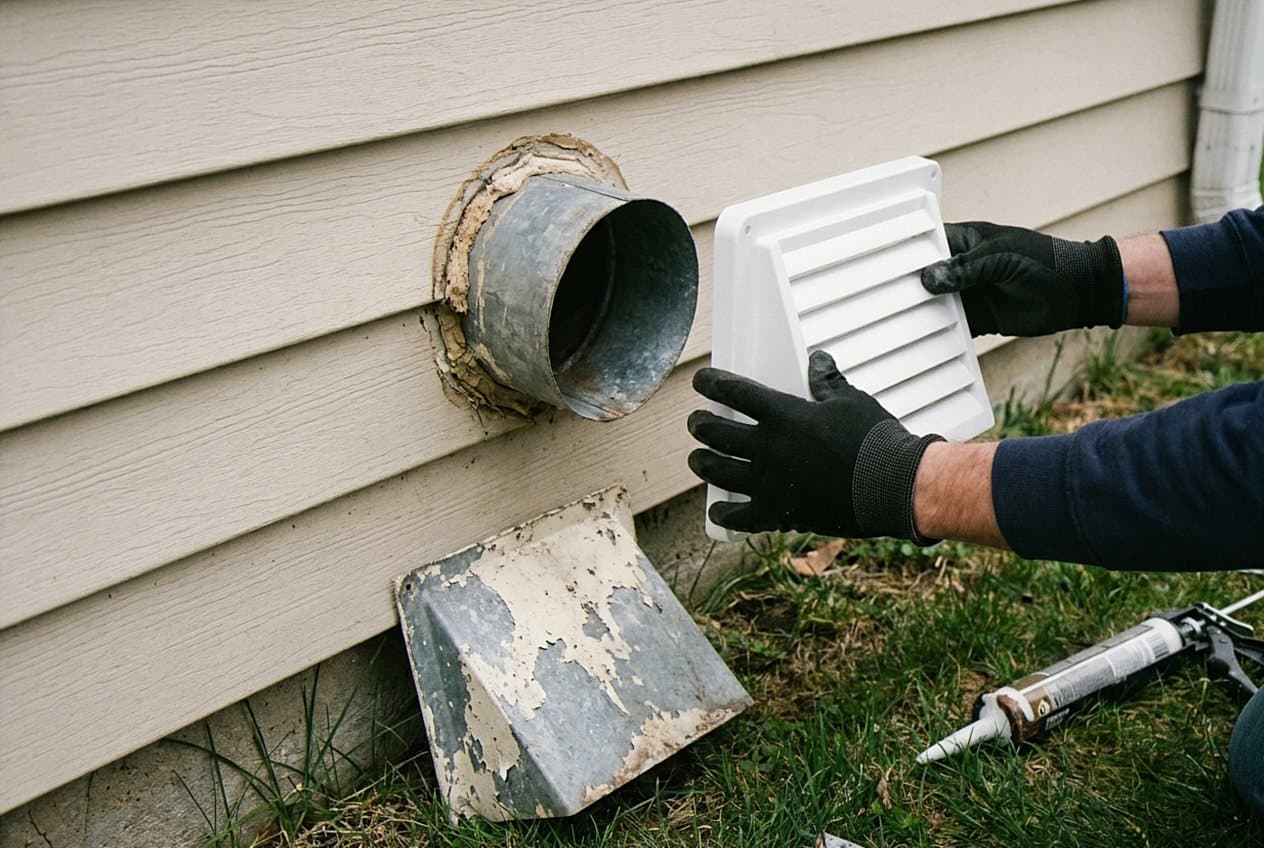
Spring brings a different problem. Starlings and house sparrows look for a warm hole in a wall, and a dryer hood with a broken flapper is exactly that. They build in April and May, and the nest goes in fast. Twigs, grass, and lint pack the last two feet of pipe solid. We pull the nest, clean the line behind it, and set a proper guard on the hood so the birds move along without blocking the air. Cottonwood season adds to it. From late May into June the fluff blows through every yard near Trout Park and the river trail, and it sticks to a damp vent screen like glue. Screens do not belong on a dryer hood in the first place. If yours has one, we take it off and fit a hood that opens when the dryer runs and shuts when it stops.
You do not need a meter to know something is off. Count the cycles. If a normal load needs two runs to come out dry, the duct is telling you something. Put your hand on top of the dryer near the end of a cycle. It should feel warm, not hot enough to make you pull away. If the room itself turns muggy while the machine runs, warm air is leaking inside the house instead of going outside. Check the floor behind the dryer for a fine gray dust that keeps coming back. Then go stand in the yard and look at the hood while a load runs. Steam should push the flap open and hold it there. A flap that trembles and falls shut is a duct that is nearly full, and it will only get worse from here.
Here is how a dryer vent cleaning visit goes. We call before we come. We park where you tell us to park, put down a mat, and slide the dryer out without scratching your floor. The hose behind the dryer comes off first, because that is where half the trouble hides. Crushed foil traps lint the way a coffee filter traps grounds. We clean that hose or swap it for smooth metal that will not collapse. Then the brush goes down the duct, turning slow, working the walls the whole way. We clear the lint trap cavity, the space under the drum, and the blower housing if the panel comes off easy. Before we leave, we run the dryer and check that the hood outside is really moving air. You watch the flapper open. That is the part people remember, because for months it was barely lifting.
We answer our own phone. Call us and you get someone who can tell you what the job takes, roughly when we can be there, and what we do if we open a wall and find a duct that was never hooked up right. That happens more than you would think. We work all over town, from the streets north of Lords Park to the blocks off Bowes Road, and out to South Elgin, Streamwood, Bartlett, and the Dundees. Rentals, condo units, and the laundry rooms in small buildings get the same attention as a house. If four units feed one shared stack, say so when you call, because we plan that job differently. And if you are not sure what you even have back there, start with a Dryer Vent Inspection.
We clear the whole vent line, machine to hood, so your dryer finishes a load in one cycle again.
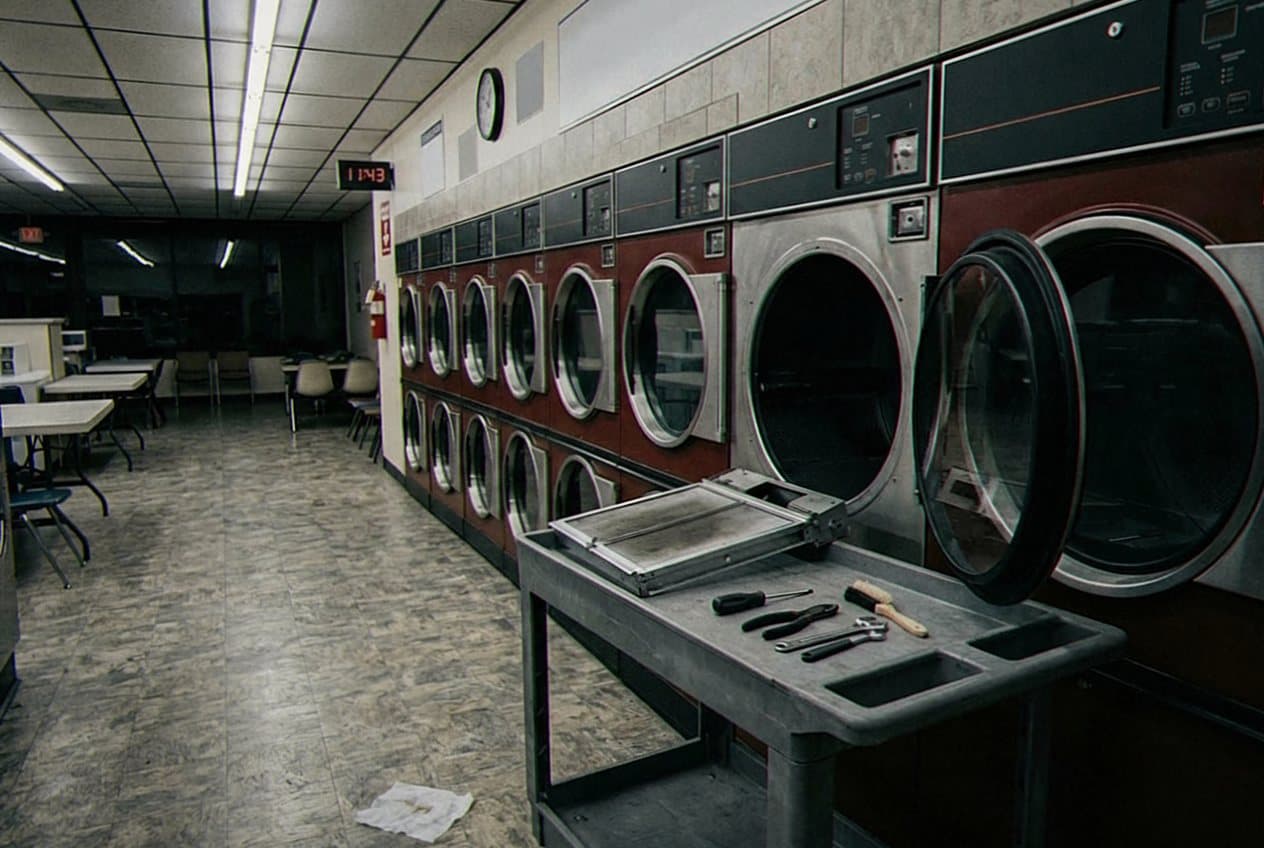
Learn moreApartment laundry rooms, laundromats, and salons across Elgin, cleaned from the machine to the outside hood.
Learn moreCrushed pipe, sagging foil, loose joints, and broken wall caps. We repair the run so your dryer can push air out again.
Learn moreA new laundry room, or a run that takes the long way around. We build the path short, in metal, and finish the outside ourselves.
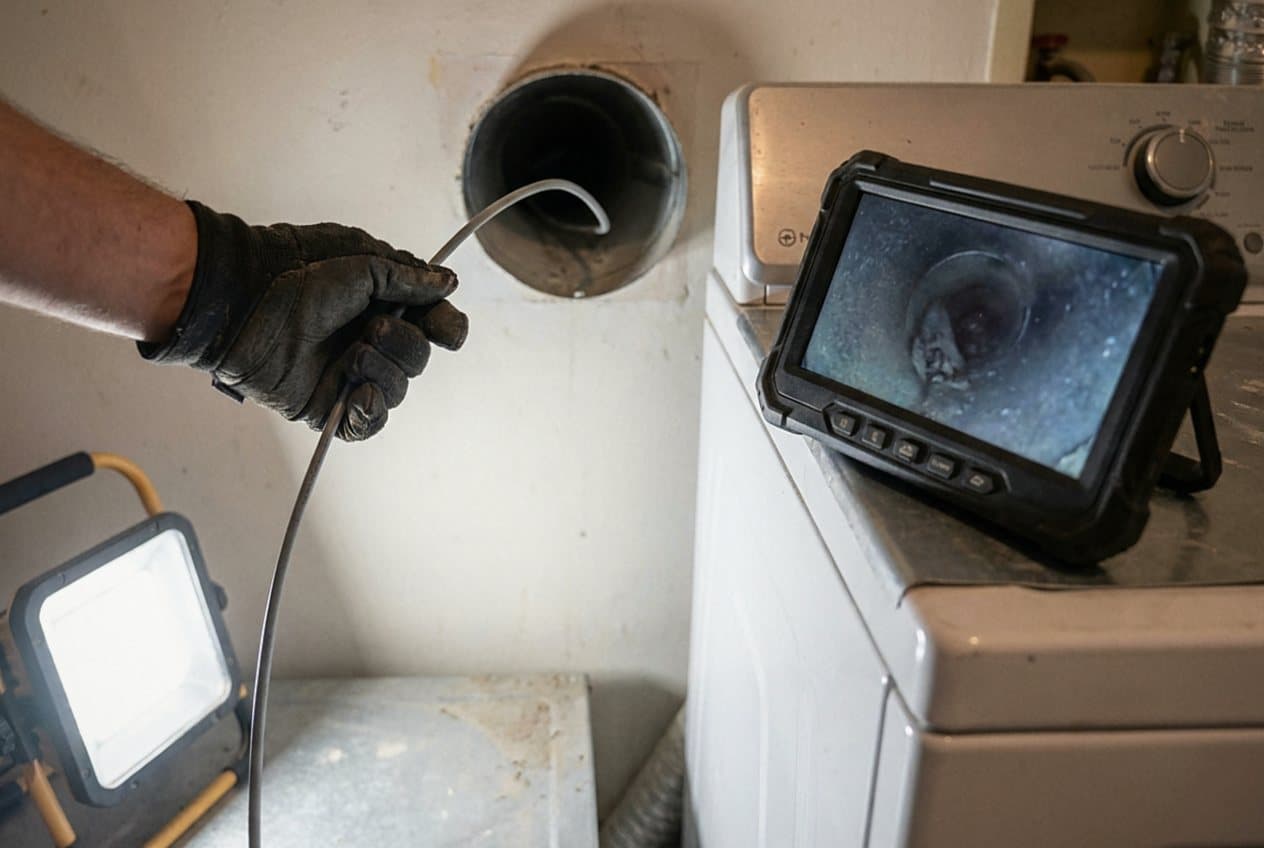
Learn moreWe send a camera down the full run and read the air at the hood, then hand you the findings in writing, with photos.
Learn moreWe clear packed lint from the whole duct run and prove the air moves again.
Learn moreA dryer duct is not one pipe. It is a chain of parts, and lint finds every joint. It starts at the lint screen, which catches maybe seven of every ten fibers on a good day. The rest goes past it into the blower housing, out the port on the back of the dryer, into the hose, into the wall, along the run, and out the hood. Every seam, every elbow, every dent in the metal gives lint a ledge to sit on. That is why a leaf blower held up to the hood does so little. Air takes the easy path down the middle and leaves the packed gray ring on the wall of the pipe alone. Brushes work because they touch metal. Ours spin on bending rods, and we add rods as we go so the head reaches the far end of a long run. The vacuum sits at the open end the whole time, so what we knock loose lands in a bag instead of on your floor. A dryer vent cleaning that skips the brush is not really a cleaning.
We check the air, not just the pipe. A dryer needs real flow to work, and you cannot judge that by feel. Before we start, we read what the hood is putting out. After we finish, we read it again and tell you both numbers. The change is usually not subtle. A duct that was moving almost nothing will push a steady stream you can feel from a few feet back. That reading also tells us when cleaning is not the whole story. If the line is clear and the flow is still weak, something else is wrong. Maybe the run is far too long. Maybe a nail went through the pipe inside a wall and crushed it, or there is a low spot where water pools every humid August. Those turn into Dryer Vent Repair work, and we will say so plainly rather than clean the same duct twice and hope.
Dryer Vent Repair is a real part of what we do, not a line on a menu. Older Elgin houses are full of duct work somebody added in a hurry. We find plastic hose buried in a wall, which should never be there. We find joints held together with sheet metal screws, and every screw points into the airflow and grabs lint like a hook. We find lines that end in a crawl space or an attic instead of outside, which dumps warm wet air right into the framing. We fix those. Smooth metal pipe, joints taped instead of screwed, the shortest path we can make, and a hood that seals when the dryer is off. When a run is hopeless, we talk about moving it. Sending the duct out a closer wall can take a fifty foot line down to twelve, and that one change does more for drying time than any cleaning ever will.
Not every fix is a cleaning. Some houses need the duct moved. When a laundry room sits in the middle of the floor plan, the run has to travel a long way, and no brush changes that math. Dryer Vent Installation & Rerouting means we pick a shorter path, cut a new opening, run smooth metal, and cap it with a hood that seals when the machine is off. On the runs we cannot shorten, a booster fan in the line gives the air the push it needs. Those fans carry a lint sensor that has to stay clean or the fan quits on you. We service the ones already in place, and we set new ones where the length calls for it. Either way we tell you which road we think is right and why, and you make the call.
Some calls are not routine. Clog & Lint Removal is what we do when the duct is already blocked and the dryer has quit doing its job. The signs are hard to miss. Clothes come out hot and still wet. The cycle runs an hour and the sheets are damp in the middle. The dryer shuts itself off partway through, because the safety switch inside is doing exactly what it should. At that point there is a solid mass in the line, and it usually sits in the last elbow before the hood or right behind a bird guard nobody has touched in years. We work it from both ends. Brush from the dryer side, hand tools and a camera at the hood, and a vacuum running the whole time. It takes longer than a normal visit. We tell you that up front instead of after.
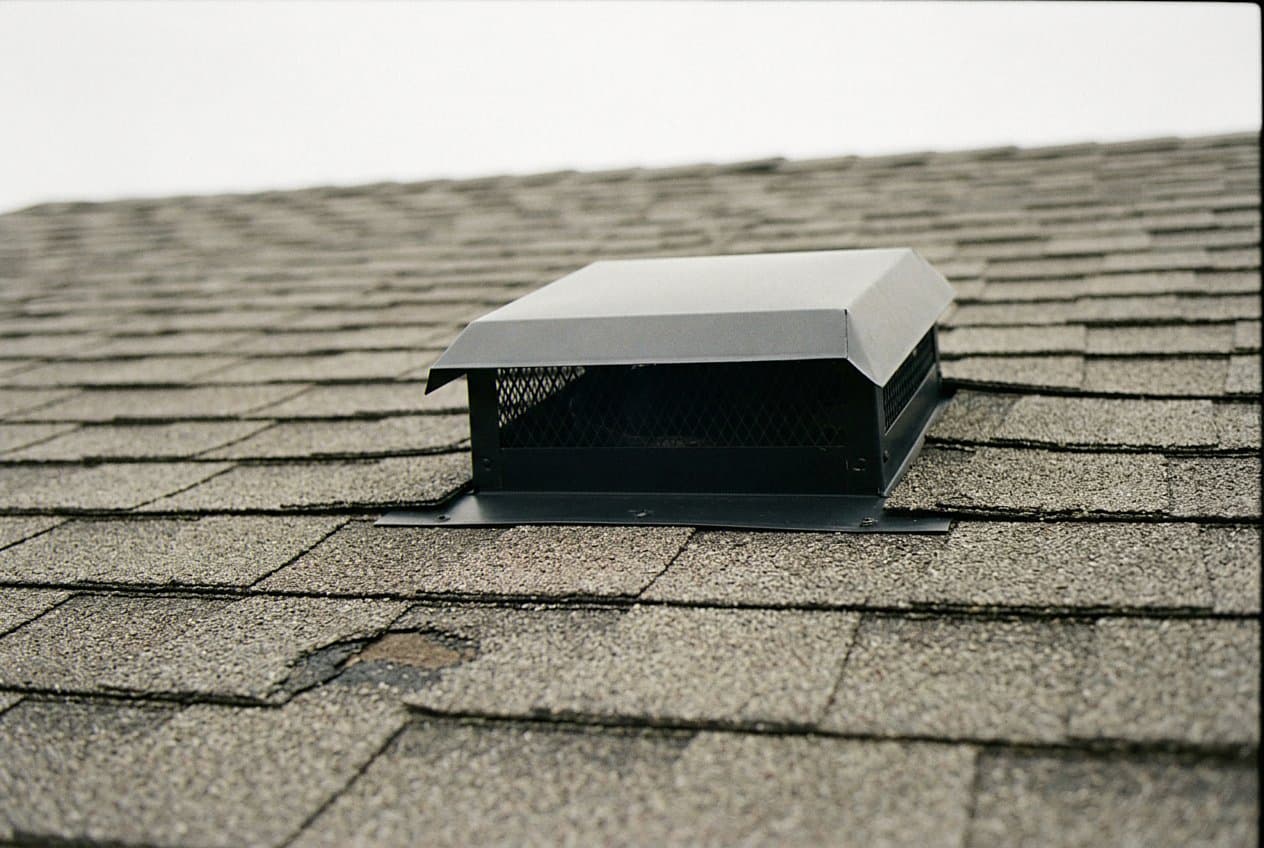
Commercial Dryer Vent Cleaning runs on a different clock. A salon in a strip center off Summit Street burns through towels all day. A building near Elgin Community College may have eight dryers feeding two roof stacks. A group home or a small inn does laundry every single day, and lint builds in weeks instead of years. We book that work when the machines are idle, which often means early morning. Roof vents get cleaned from above with the same brush and vacuum, plus a look at the damper, because a stuck damper on a roof is what turns a shared stack into a hazard. We keep notes on what we found and what we cleared, so the next visit starts from something real. Most property managers want a rhythm rather than a rescue. Commercial Dryer Vent Cleaning on a set schedule is how they get one.
There is plenty you can do between visits, and we would rather you know it. Clean the lint screen every single load, not every third one. Once a month, pull the screen out and rinse it under hot water, because dryer sheets leave a film you cannot see and air cannot pass. Look behind the dryer twice a year and make sure the hose is not kinked into a horseshoe. Walk outside and watch the hood while a load runs. If the flapper barely lifts, the line needs help. If you find lint on the siding under the hood, air is getting out but so is the lint, which means the duct is shedding what it should be carrying. Good dryer vent cleaning lasts longer when the screen stays clean too. None of that costs you more than ten minutes a month.
How often should this happen? For a normal household of three or four people, once a year is a fair rhythm for dryer vent cleaning in Elgin. Big families, pets that shed, or a laundry room on the upper floor push that closer to every eight or nine months. One person running two loads a week can often go longer. If you are not sure, a Dryer Vent Inspection answers it without guesswork. We scope the line, read the flow, look at the hood, and tell you where you stand. Sometimes the honest answer is that your duct is fine and you should call us next year. We would rather say that and earn the next call than sell you work you do not need. New owners get the most out of it, because nobody knows what the last owner did behind that wall.
Call or send the short form with what is going on at your place. A sentence or two is plenty.
We go over the situation on the phone, ask the questions that matter, and tell you what we would do next.
You get a plain rundown of the work, the order it happens in, and what to expect on the day.
We hand the work back with a final look together, so you see exactly what was done and why.
Serving Elgin and the surrounding Kane.